
Nazarlik and Çengel of Anatolia
This is the introduction to my personal collection, and a recollection of my encounter with an extraordinary object in a Kuşadası doorway in 1997 that began a fascination that has endured for thirty years.
What started as an appreciation of an unusual piece of folk art has gradually developed into a collection and an investigation of Anatolian protective traditions, craftsmanship and changing ways of life.
What started as an appreciation of an unusual piece of folk art has gradually developed into a collection and an investigation of Anatolian protective traditions, craftsmanship and changing ways of life.
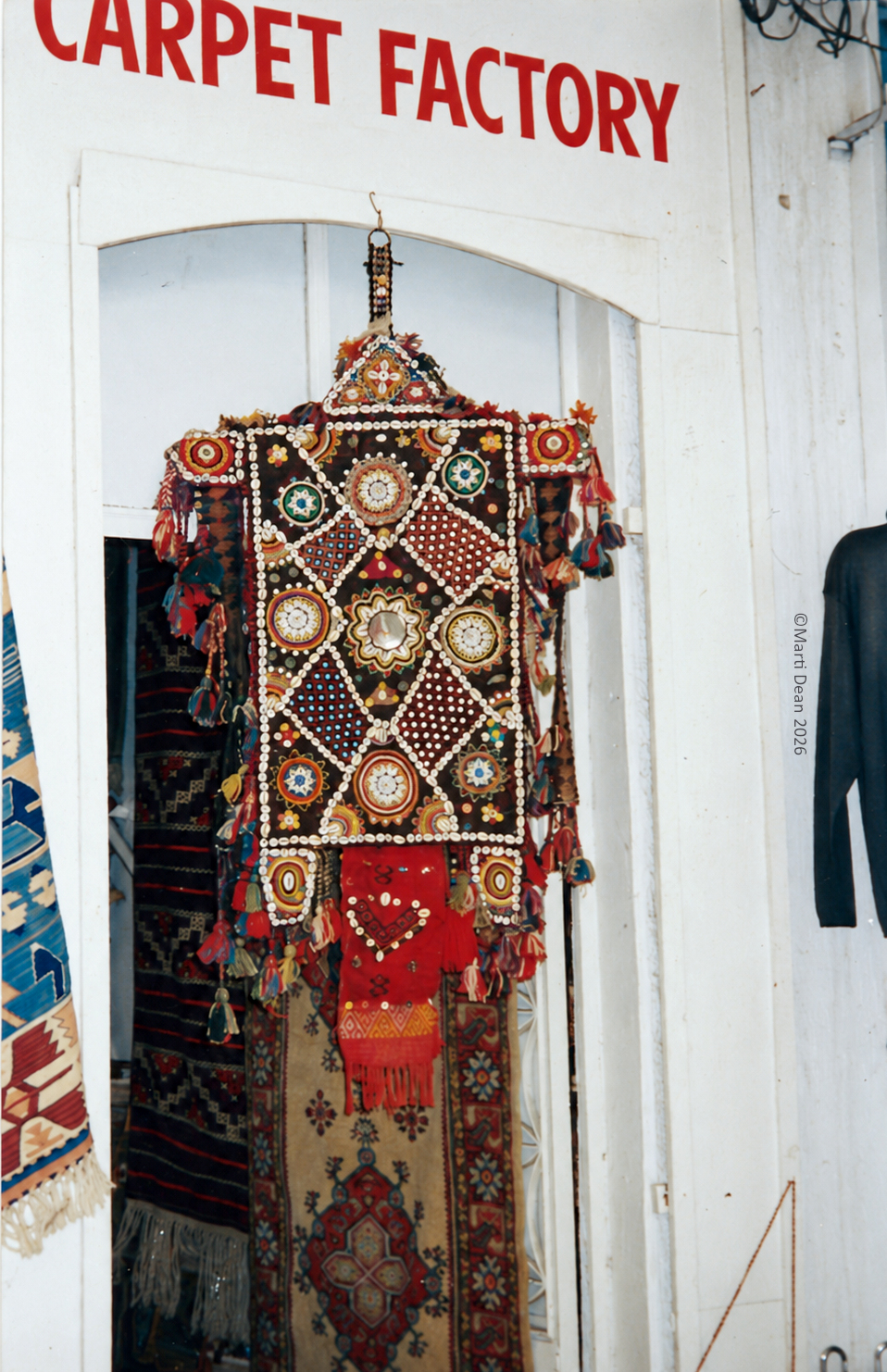
Image taken in Kusadasi in 1997
An Encounter in 90s Kuşadası
In 1997, after many years of wanting to visit Türkiye and the ancient city of Ephesus, I travelled to Kuşadası with my parents. The old town of Kaleiçi was then a colourful mixture of carpet shops, workshops and small businesses selling textiles, ceramics, jewellery and traditional crafts. During one of our excursions, I noticed an extraordinary object hanging in the doorway of a carpet and kilim shop, close by the Old Town.
Roughly rectangular, it was an exuberant arrangement of wool, tassels, cowrie shells and glittering embellishments. My longstanding interest in magical traditions suggested that it was an apotropaic object, intended to avert misfortune or harmful influences. In purpose, if not appearance, it reminded me of the antique, mirrored witch balls I collected at home.
I photographed the hanging, and although I had no opportunity to investigate further, it remained firmly in my imagination throughout the year. I kept returning to the enigmatic photograph wanting to know more.
When we returned to Kuşadası in 1999, finding the shop became a priority. The original hanging had disappeared, but inside I discovered several others displayed among the carpets and kilims.
They varied considerably in form and decoration, but one immediately attracted my attention. Suspended on the far wall was a large, elaborately embellished hanging whose outline vaguely resembled a hamsa, the protective hand motif familiar throughout the Middle East and Mediterranean. It was quite different from the object I had photographed, but considerably more attractive to my eye than the other examples.
I asked one of the shop staff about the hangings. He consulted his colleague in Turkish, and during their exchange I recognised the English word "nomads". The dealer explained that the objects came from eastern Turkey and were made by nomadic people. I also recall references to tents and to people travelling with their animals, although all the details of the conversation have faded somewhat. After considering the other examples, I decided to purchase the large hanging. It cost approximately £95.
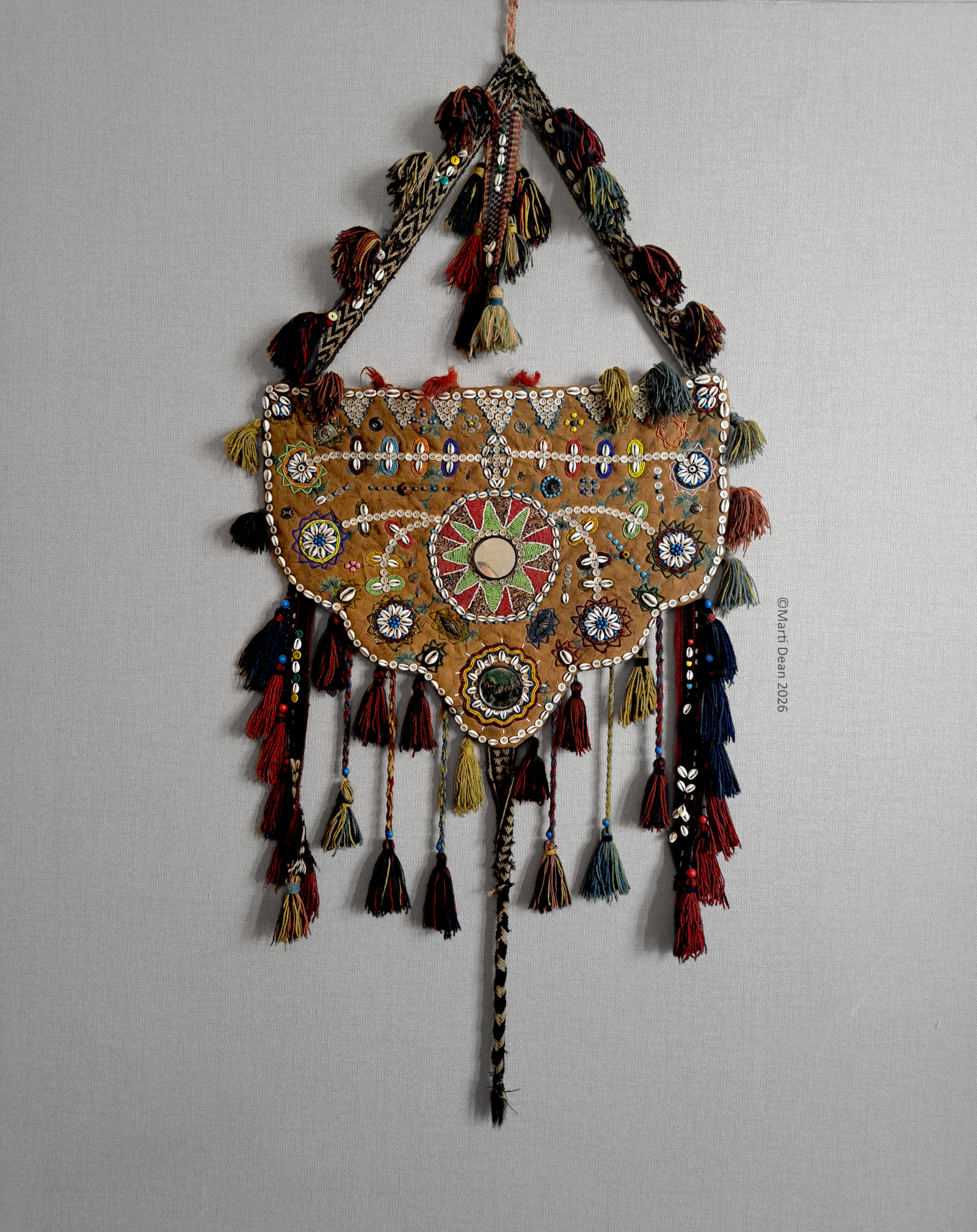
My original nazarlik, purchased in 1999 in Kuşadası
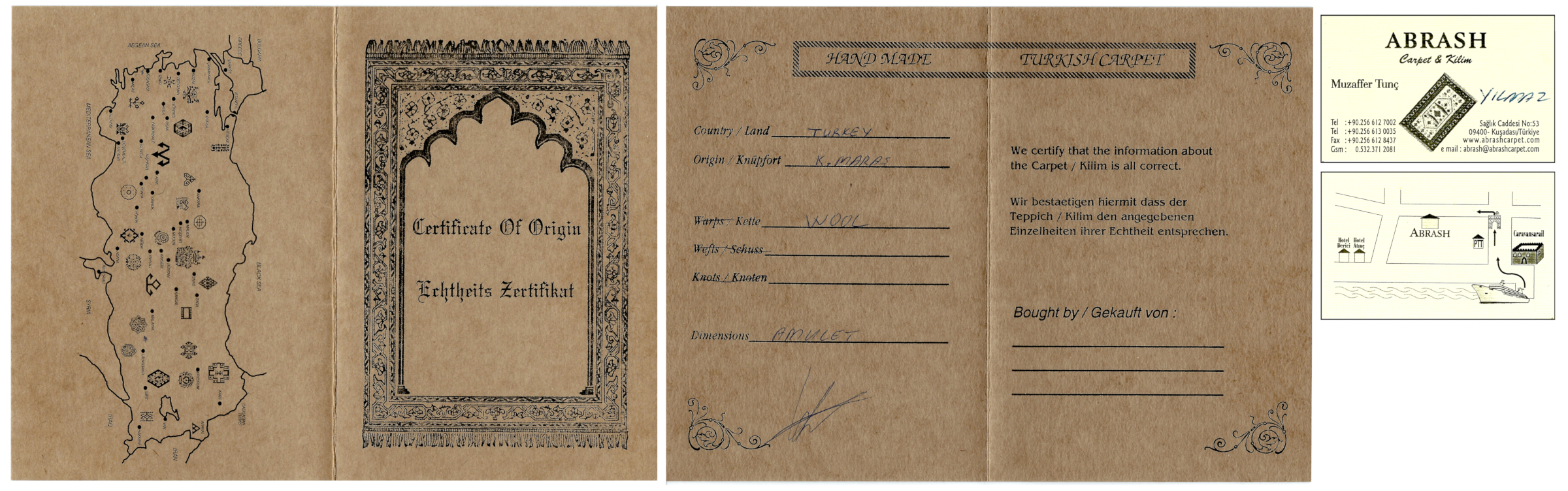
Certificates and card accompanying my purchase.ı
The dealer completed a small folding certificate, indicating the object's reported place of origin on a map of Turkey, while his colleague wrapped it for the journey home.
The documentation accompanying that first purchase has since proved particularly valuable. The shop was Abrash Carpet & Kilim, at Sağlık Caddesi No. 53, Kuşadası. Its business card carried the name Muzaffer Tunç, with Yilmaz written as the name of the man who served me. The certificate described my purchase simply as AMULET. Its country of origin was recorded as Turkey, with the regional designation K. MARAS, referring to Kahramanmaraş.
The Kahramanmaraş region has a long history of Türkmen and Yörük communities, particularly those associated with the Dulkadirli confederation. During the Ottoman period, many groups, including the Avşar, Eymir, Akçakoyunlu and Kızıllı, followed seasonal migrations between the mountain pastures of the Taurus ranges and warmer lowland winter settlements. Their livelihoods centred largely on sheep and goat herding, alongside small-scale agriculture. Over the following centuries, many communities gradually adopted settled lives, a process accelerated by Ottoman settlement policies during the nineteenth century. This pastoral heritage provides a possible cultural context for the amulet I purchased in 1999.
Collecting and Making Nazarlık
It was only many years later that I encountered the Turkish term ‘nazarlık’ as I had previously been using the description written on my card – Amulet.
The word refers broadly to objects intended to protect against nazar, the harmful influence commonly understood as the evil eye. Such objects range from familiar blue glass eye beads to elaborate textile hangings.
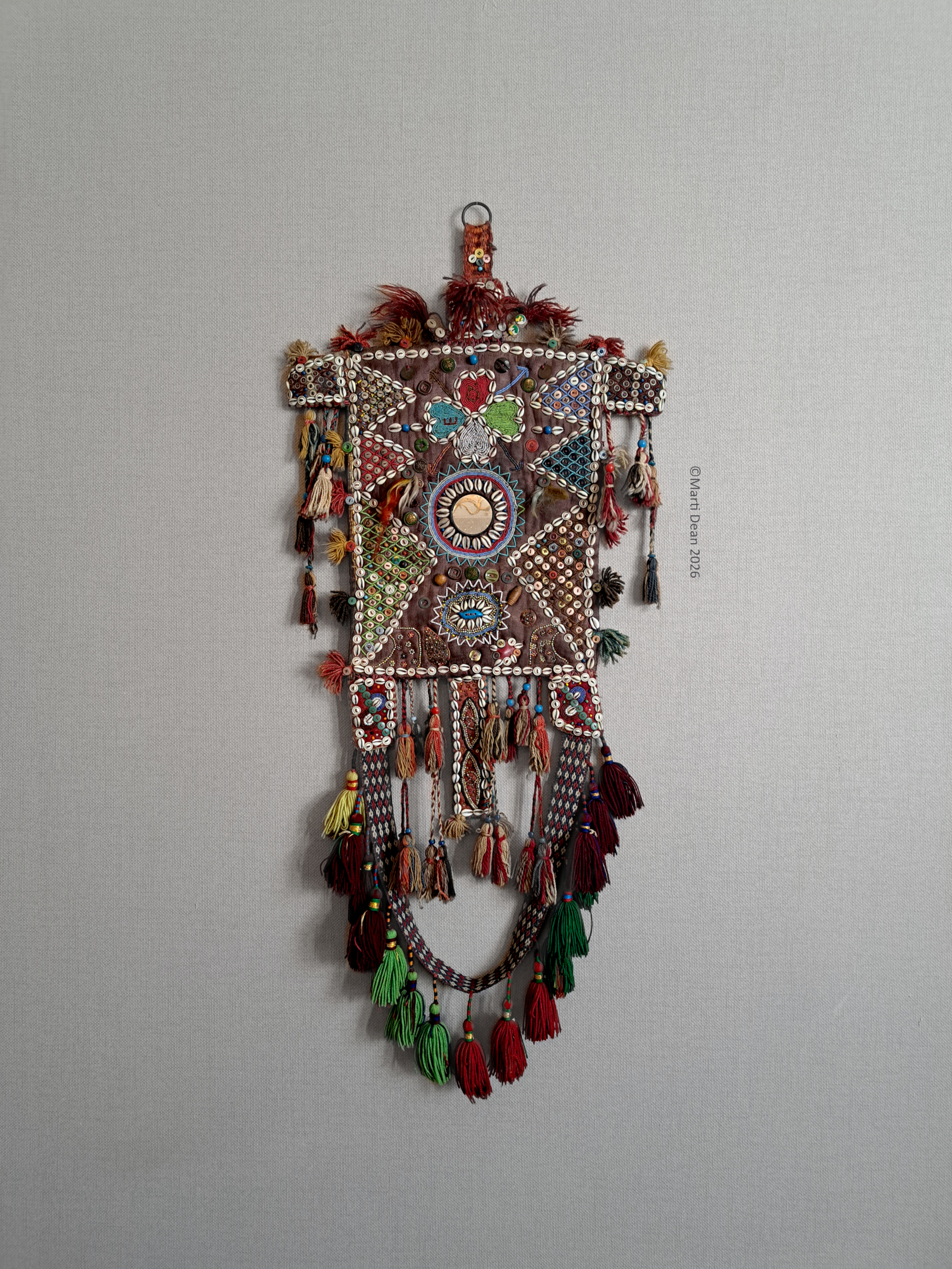
The examples that interested me were particularly diverse. They could be circular, rectangular, triangular or vaguely anthropomorphic, incorporating mirrors, cowrie shells, beads, coins, metal ornaments, woollen tassels, goat hair, sequins and repurposed materials.
Following my early visits to Türkiye, the last being in 2001, more than two decades passed before I was able to return. Nevertheless, my collection continued to grow.
Traditional nazarlık were not especially easy to find. Examples occasionally appeared in online auctions, frequently misidentified as bohemian wall hangings, hippie decorations or dreamcatchers. I also contacted Turkish carpet dealers directly to enquire as to whether any were amongst their stock. Over time, I acquired examples of varying ages and styles. Some were brightly coloured, relatively recent creations; others were faded, worn and extensively repaired.
I became particularly interested in the older pieces. Their uneven tassels, asymmetrical arrangements and irregular stitching possessed a spontaneity that I found appealing. They seemed to convey something of the wild landscape of Anatolia. As a trained silversmith and goldsmith, I was also fascinated by their construction. I studied the stitching, braiding, tassels and methods used to incorporate shells, beads and other embellishments.
Eventually, I began making my own using the techniques and motifs I had observed in my own collection. My first attempt was a carefully composed red wool hanging, almost mandala-like in its symmetry. Although a successful piece in terms of composition, it lacked the irregular character of the Anatolian originals, and in particular, the magic of being crafted by Turkish hands from local materials.
A second piece, incorporating older materials and a more spontaneous arrangement, came closer to the aesthetic I admired. Both experiments gave me a greater appreciation of the ingenuity, skills and labour involved in making these objects. The original pieces and techniques used to make them were my teachers.
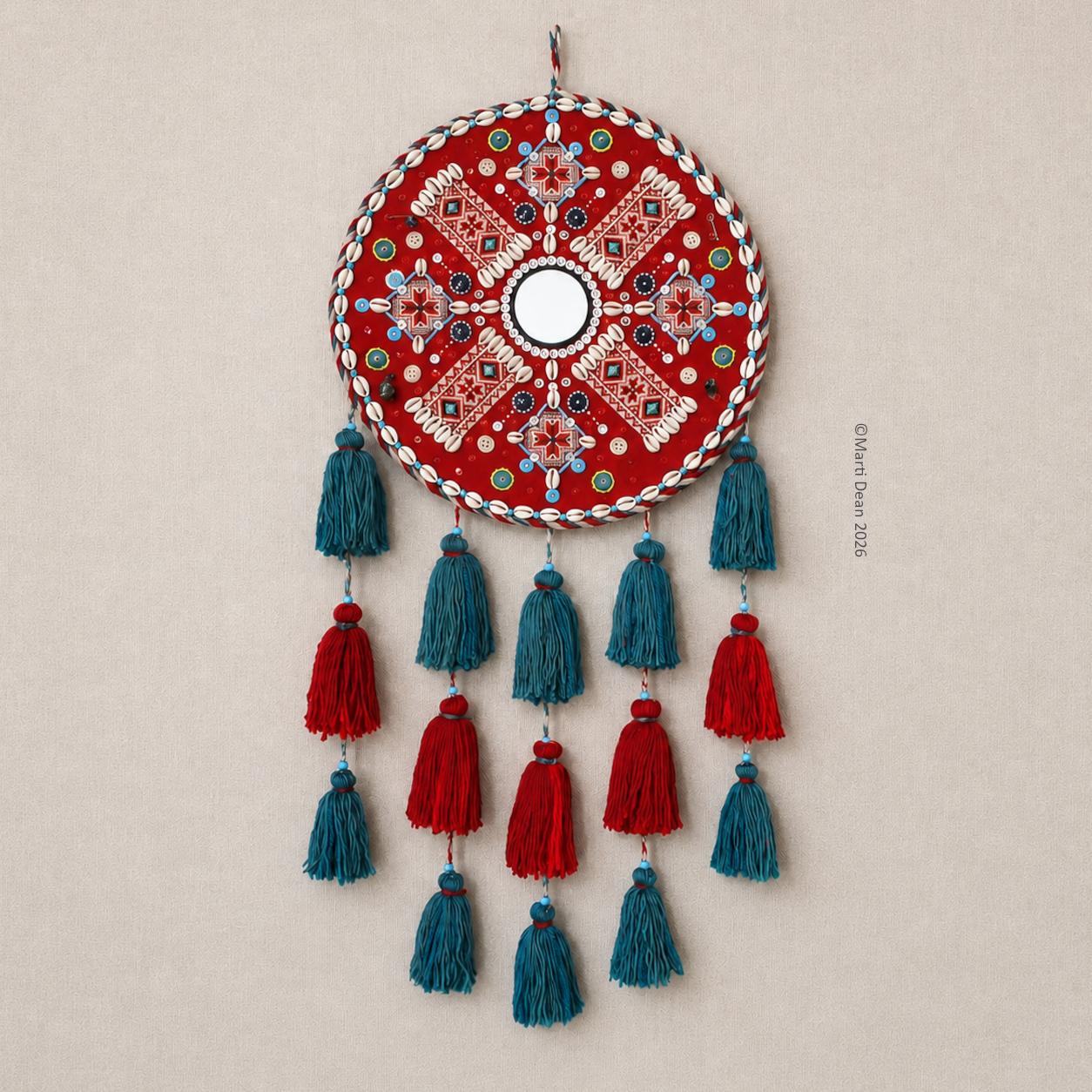
My first attempt at making a nazarlik in 2015
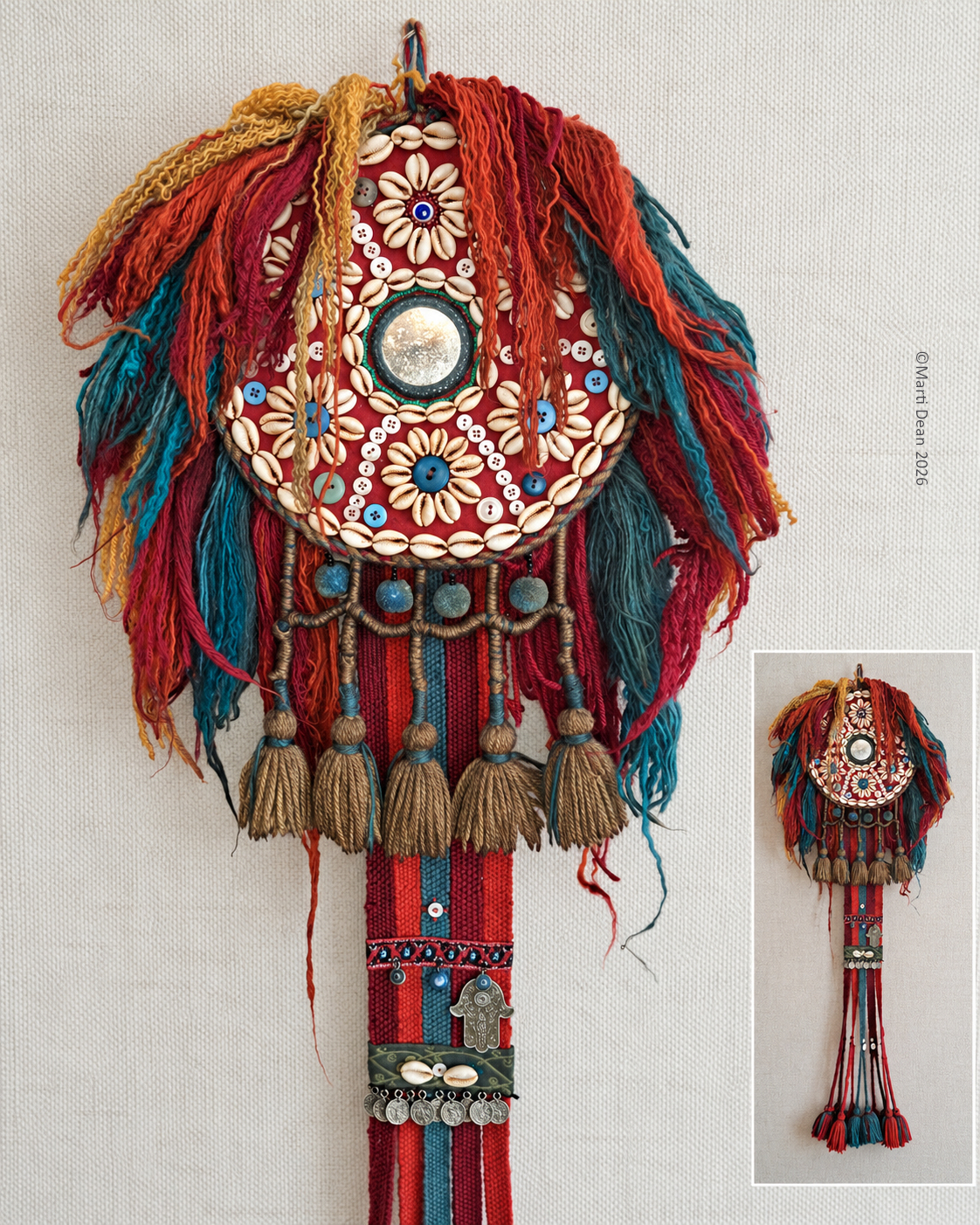
My second attempt at making a nazarlik in 2016
The Language of Protection
The protective qualities of nazarlık extend beyond their motifs to the materials used in their construction. Eşref Bülent's study of "çılkak" (cowrie shells, "Cypraea moneta") describes their use on children's clothing and hair, women's belts and jewellery, and domestic animals, particularly wrestling camels. Associated with protection against "nazar", fertility and birth, these small shells could serve as both ornament and amulet.
Flowers, leaves and geometric patterns also carry traditional associations. Naile Rengin Oyman records floral motifs such as "gül", "çiçek" and "yaprak", linked in published classifications with abundance, happiness and paradise. The "yonca yaprağı", or clover leaf, is associated with luck and "kısmet" (good fortune). Diamond-shaped "baklava" patterns sometimes appear alongside protective eye and "muska" motifs (Oyman, 2019; Eroğlu, 2022; T.C. Millî Eğitim Bakanlığı, n.d.). However, meanings vary between regions and makers. Even apparently familiar shapes, such as hearts, should not automatically be given a particular interpretation. Love and marriage may instead be represented through named motifs including "aşk-birleşim" (love and union), "saç bağı" (hair band, associated with marriage), "küpe" (earring, associated with courtship) and "sandık" (bridal chest or dowry).
Protection is not necessarily confined to symbols. Colour, reflection, movement, sound and even fragrance may contribute. Saul Barodofsky describes bright colours, patterns and movement as ways of distracting harmful attention. Blue and turquoise are particularly associated with protection against the evil eye. The colourful buttons found on many nazarlık seem to serve a similar visual purpose, while also being inexpensive and easily incorporated into decorative designs.
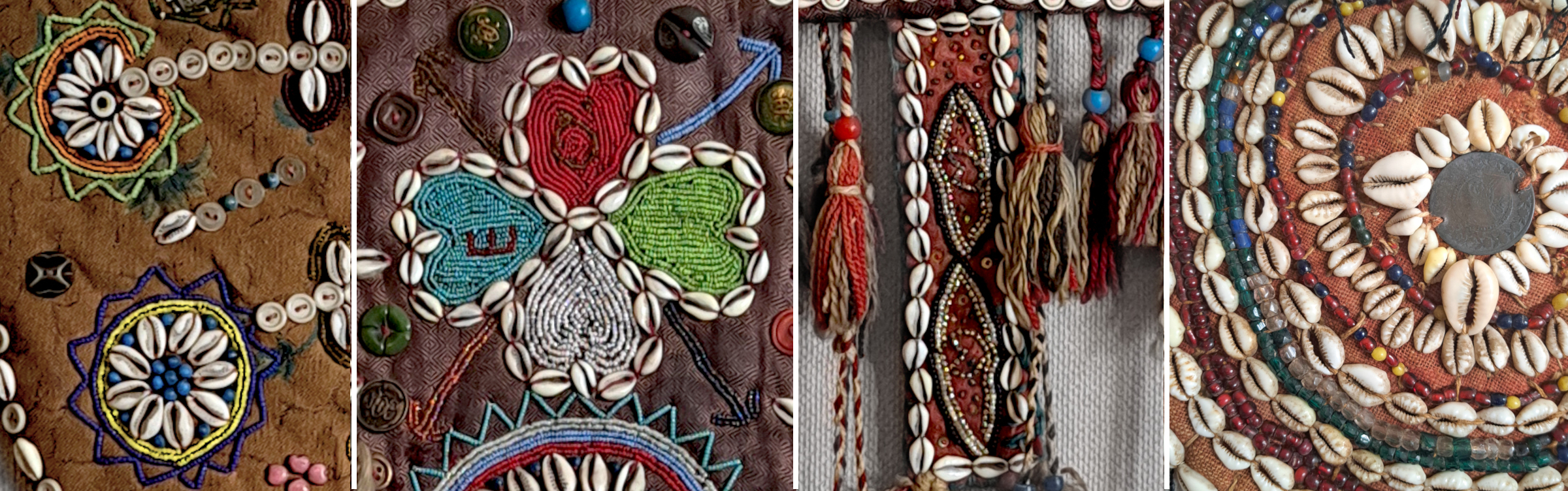
Mirrors, coins and polished metal catch and reflect light. They remind me of the mirrored witch balls traditionally used for protection in England, and of my Afghan 'shaman's mirror', made from rows of small mirrors threaded together with cloves. One of my older nazarlık has an Ottoman coin at the centre of a circular arrangement of cowries, creating a similarly eye-catching effect.
Movement is another characteristic. Long tassels, fringes and bundles of wool shift in the air, bringing the hangings to life. One of my own amulets incorporates brass ornaments, thimbles and cowries that produce a gentle jingling sound when disturbed. Such sounds add another sensory dimension to these objects.
Fragrance, too, has a place in protective traditions. The cloves incorporated into my Afghan mirror release a distinctive scent associated with warding off negativity. In Turkey, "karanfil kolyesi", or clove necklaces, have traditionally been worn by brides and young women. A Palestinian Museum example also records a clove necklace believed to protect against spirits. Although these practices belong to different traditions, they illustrate how fragrance, decoration and protective belief can overlap (Aydın University, n.d.; Palestinian Museum, n.d.).
Taken together, the shells, colours, mirrors, coins, tassels, sounds and fragrances suggest a remarkably varied language of protection. These objects appeal to several senses at once, helping to explain both their traditional significance and the extraordinary visual character that first attracted me to them.
A Hare for the Museum of Witchcraft and Magic
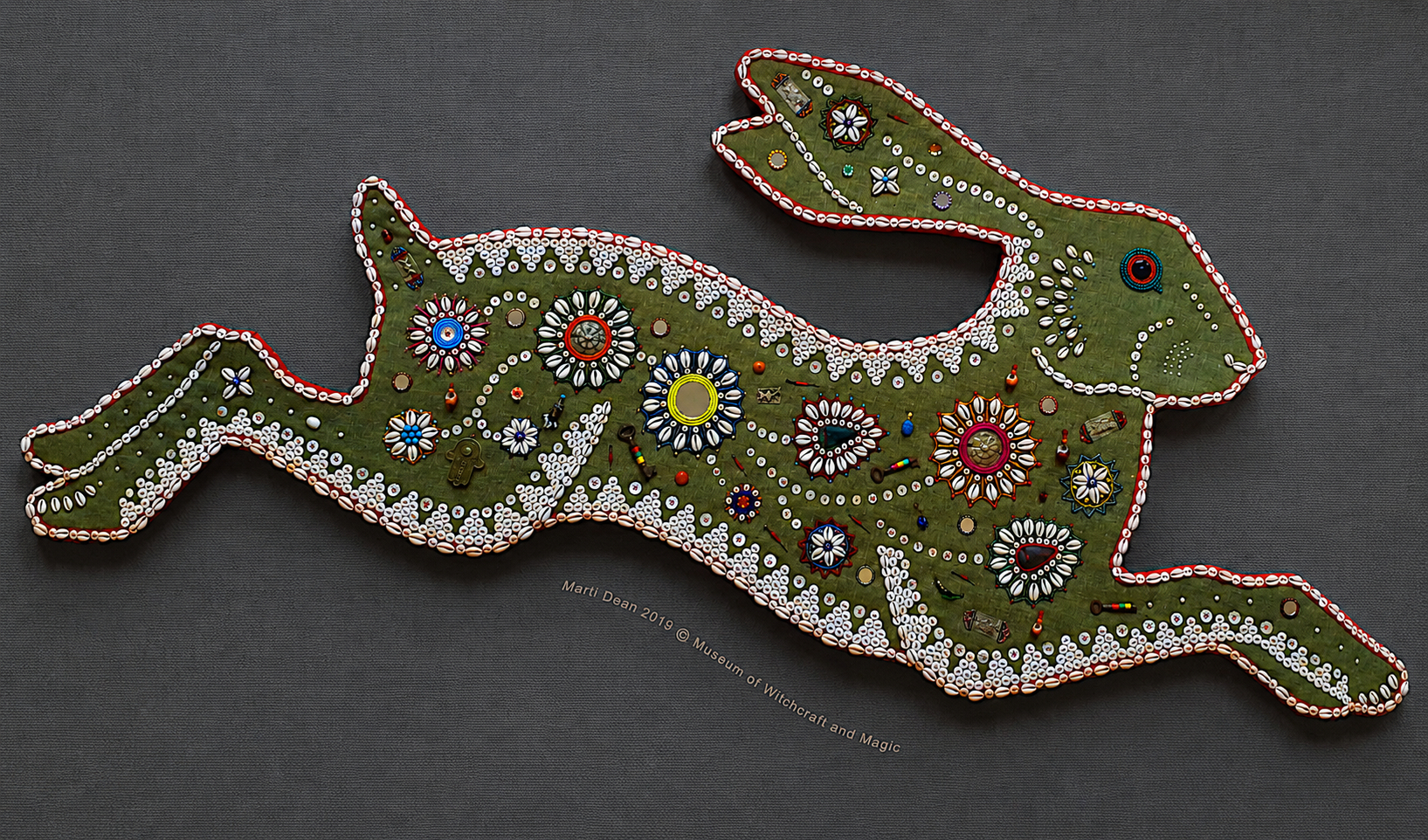
Large hare amulet made in 2019
My friend Simon, the museum's director, invited me to contribute to a window installation associated with the Scottish witch Isobel Gowdie, whose confessions included accounts of transforming herself into a hare.
Rather than create a conventional sculpture, I proposed a large hare constructed using techniques and decorative elements inspired by Anatolian protective hangings. It was an opportunity to use all of the techniques I had learnt from scrutinising the Turkish original pieces in my collection.
The finished work, almost as tall as I am, combined felt, fabric, buttons, cowries, and other magical amulets such as bound keys, blackthorns and arrow heads. It was my contemporary interpretation rather than an attempt to reproduce an authentic nazarlık, and its inspiration was acknowledged in the accompanying museum text.
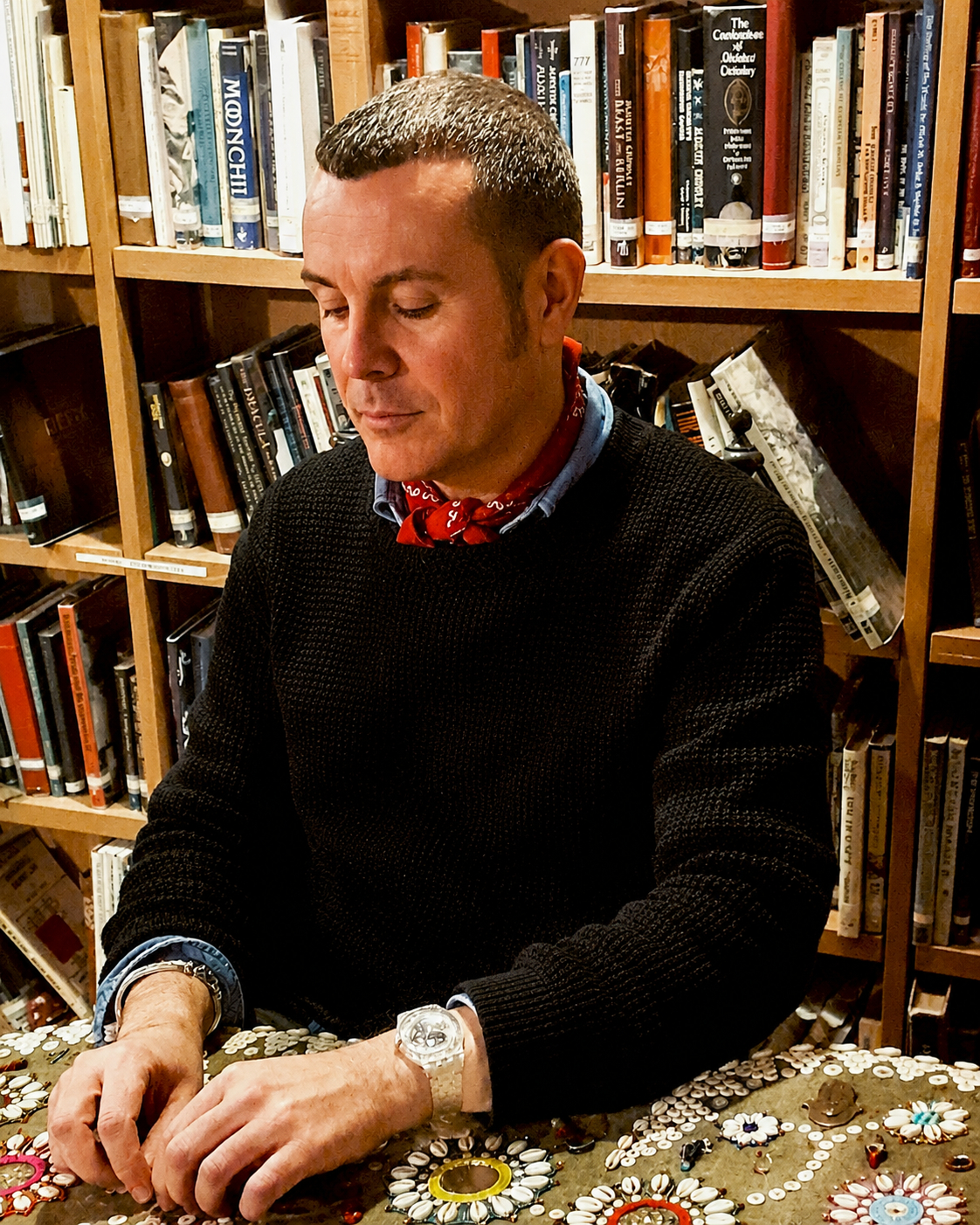
Finishing touches in the museum's Library
A Changing Türkiye
In 2025, after more than twenty years away, I returned to Türkiye, hoping to acquire further examples of the protective hangings I remembered from the carpet shops of Kuşadası. However, the town had changed considerably. Kaleiçi appeared increasingly dominated by contemporary retail businesses, and traditional carpet shops seemed less numerous. More significantly, none of the dealers I visited had the nazarlık I was seeking. Armed with photographs of my collection, my travelling companion and I visited numerous carpet and kilim businesses.
I had many memorable encounters with Ali, proprietor of Didim Carpets, whose family had a longstanding association with the town having been in business there since the early 1970s. A warm and friendly man, he examined my photographs with considerable interest but explained that such hangings were no longer readily available to dealers. Other sellers offered similar accounts.
During two further visits to Türkiye in 2026, I continued my enquiries in Selçuk, where I was staying. Here I became acquainted with Şerif, an archaeologist whose family has operated a carpet and kilim business close to Ephesus Museum for many years. We discussed archaeology, textiles and regional history, and he showed me many remarkable old carpets, kilims and other objects. He recognised my nazarlık as older examples and confirmed that similar pieces were now difficult to obtain.
These conversations raised questions about the people who had made the hangings and the circumstances that had led to their declining availability.
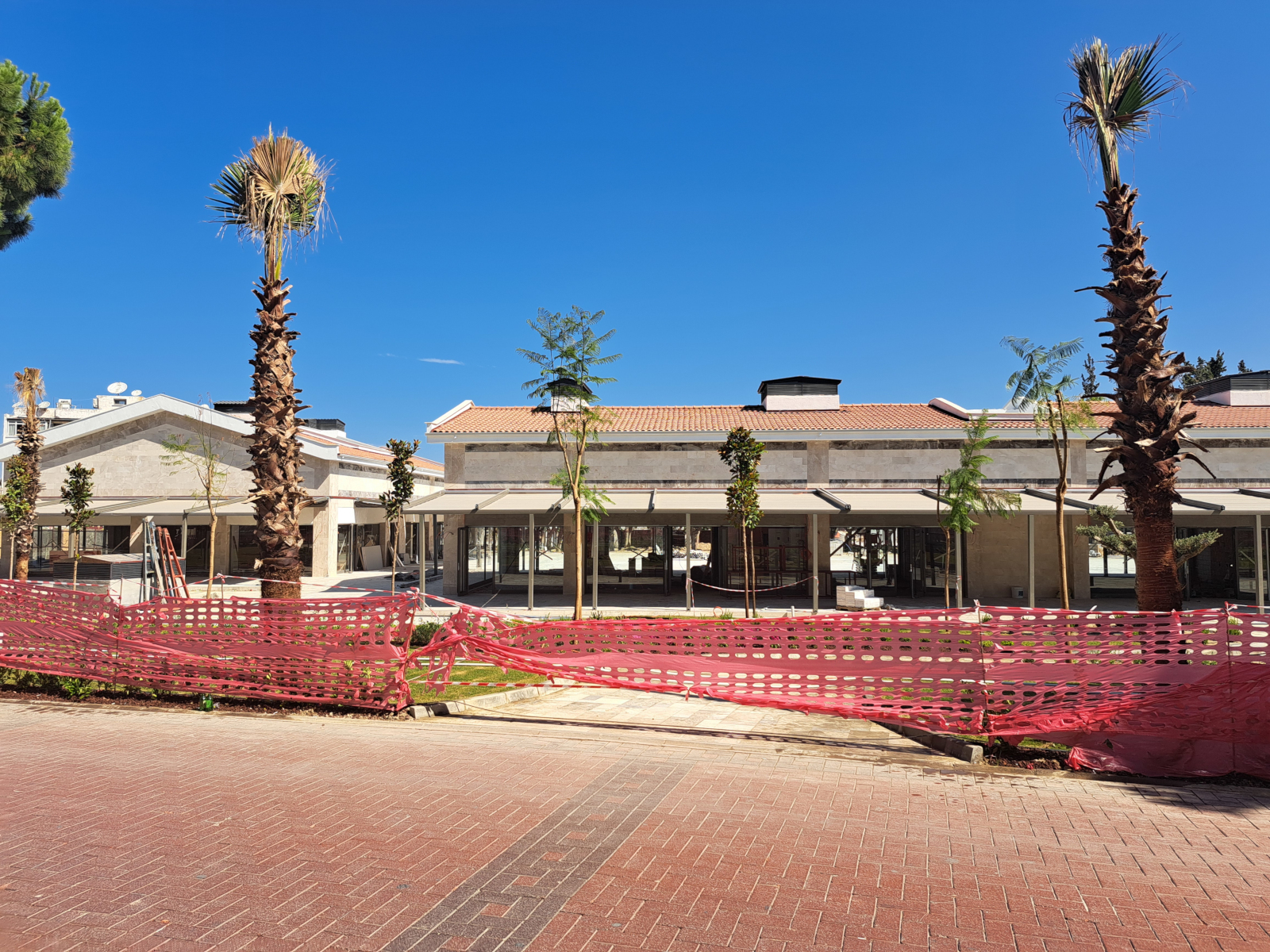
The continuous changing face of Kusadasi- new buildings in 2026
The Makers of the Amulets
An important discovery was a June 2018 interview with Mustafa and Zarife Bozkurt, an elderly couple living in Durukaynak, formerly Pişnik, in Adıyaman Province. The Bozkurts produced traditional textiles, including protective hangings they called çengel. Zarife had learned weaving from her mother-in-law and passed her skills to her daughters. Their work provided income that helped support the family, including their children's education and marriage expenses. Materials were obtained through local networks, while their son supplied decorative beads from İzmir. Finished products were distributed to neighbouring settlements and markets.
The interview offered a valuable insight into the practical circumstances of traditional textile production.
The Bozkurts were not anonymous representatives of an imagined, unchanging Anatolia. They were craftspeople whose work was shaped by family responsibilities, available materials and economic necessity. Advancing age and diminishing family assistance were making it increasingly difficult for them to fulfil orders, illustrating how traditional production could decline even where demand remained.
The interview was particularly interesting because at least one hanging in my collection closely resembles examples photographed with the couple. Its proportions, bead arrangements and fine woollen tassels display striking similarities. The term çengel was another significant discovery, indicating that particular forms of protective hanging could have more specific local names than the broader designation nazarlık.
Kevser Gürcan Akbaş documents a particularly clear example: a Gaziantep çengel, which is also remembered in villages around Gaziantep and Malatya as a ‘gelin habercisi’, or bridal messenger. A young boy from the bride’s side carried it ahead of the procession to announce that the bride was on her way. After her arrival, women viewed it with the dowry, and afterwards it was hung in a treasured place in the new home as a nazarlık. The materials and workmanship were understood to show both the family’s means and the bride’s skill at sewing. This one object therefore linked the wedding procession, the display of the dowry and protection in the bride’s new household (Gürcan Akbaş, 2020).
Nazarlik functions could therefore extend beyond household protection, encompassing decoration, family ceremonies, protective horse and camel trappings and eventual commercial exchange.
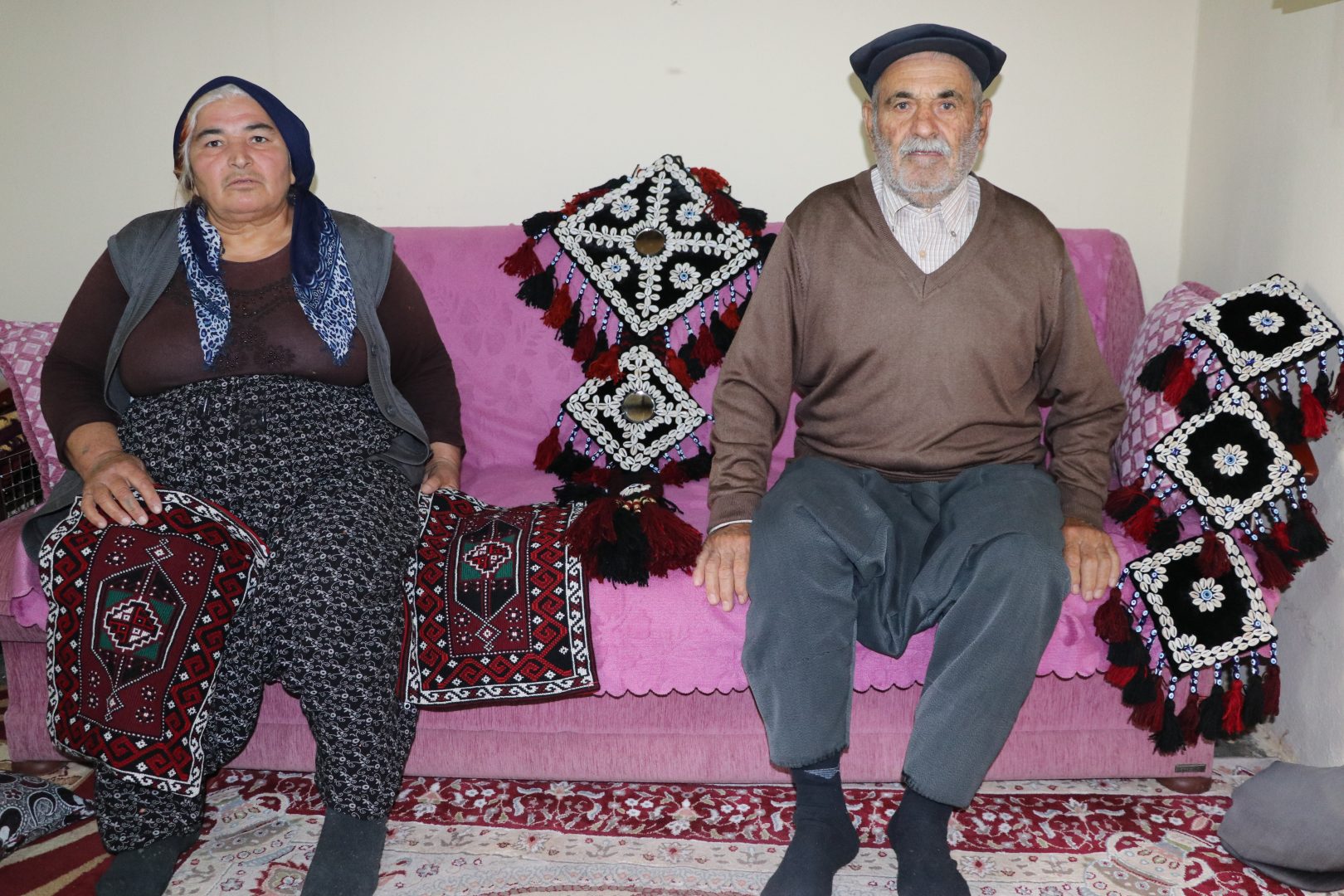
Mustafa and Zarife Bozkurt - Pirha article linked here
Why Have Older Nazarlık Become Difficult to Find?
The reduced availability of traditional nazarlık in western Turkish carpet shops is likely to reflect several interconnected developments. Research into Turkish handweaving has examined the effects of industrial production, changing markets, labour costs, education and alternative employment opportunities.
Kimberly Ann Berman's 2006 study of Turkish carpet weavers and Bahadır Öztürk's research into handmade carpet production after 2000 provide useful context, although neither specifically establishes the causes of declining nazarlık production. The Bozkurt family illustrates one possible consequence of social change. Their textile work helped finance educational and economic opportunities for their children, potentially contributing to circumstances in which younger generations were less dependent upon traditional crafts.
Some hangings may have originated in tents or rural households, while others could have been produced by settled craftspeople or made specifically for commercial sale. The carpet shops of Kuşadası formed part of a wider network through which these objects circulated. As production and demand changed, older stock may have dispersed into private collections and the second-hand market.
Their declining visibility in the shops I visited does not necessarily indicate the disappearance of related traditions elsewhere. Contemporary Turkish makers continue to produce colourful protective hangings, often with more regular compositions and modern decorative materials. Their appearance may differ from the older examples I collect, but they demonstrate the continuing adaptation of protective folk art.
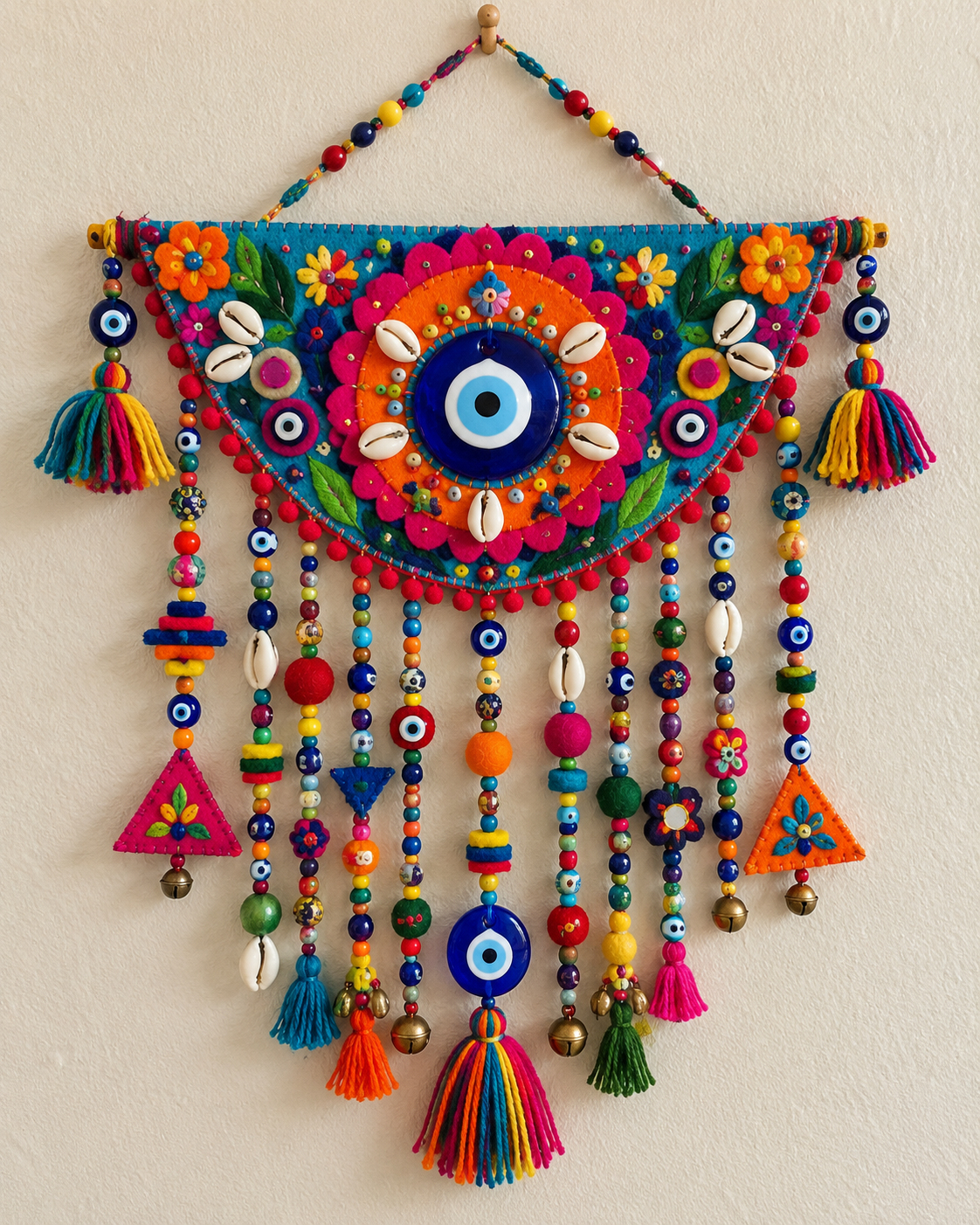
A contemporary crafted nazarlik
Silent witnesses to the passage of time
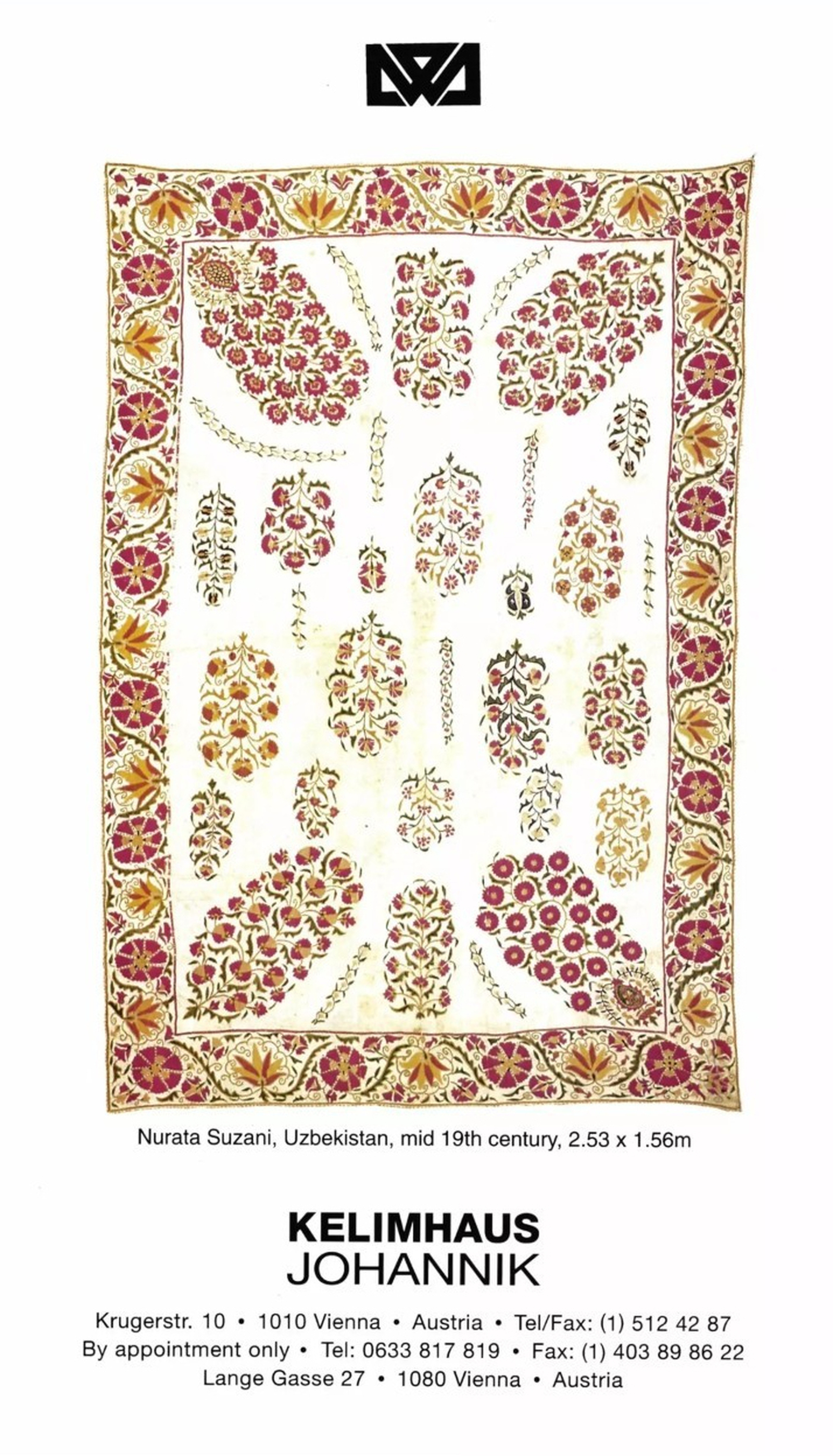
Following my return from Türkiye in 2026, I acquired several older pieces from a European seller who attributed them to the former stock of Heinz Johannik, a Viennese textile dealer associated with Kelimhaus Johannik. According to the seller, Johannik had travelled extensively in search of Oriental textiles during the 1950s–1970s, and she had acquired his remaining stock in 2014.
The pieces were attributed by Heinz Johannik to the late nineteenth or early twentieth century. Their forms suggested possible use as protective or amuletic camel trappings, but it was also clear from the compressed wool on their reverse sides that they had hung against a flat surface for many years.
These hangings wear their history with pride, faded, frayed and sometimes extensively repaired, they preserved evidence of prolonged use. Their reverse surfaces were often as revealing as their fronts; original, thick cream-coloured stitching appeared alongside later interventions in red, black and other threads. Shells had been reattached, straps repaired and decorative elements replaced and added.
Having made similar objects myself, I could recognise construction techniques and understand the practical reasons for certain repairs. Old glass beads, oxidised metal ornaments, coins, hair, worn braiding and elaborate tassels provided further evidence of their materials and workmanship. Occasionally, fragments of vegetable fibre remained caught within the wool during their creation.
Such details suggested long and complex histories, their materials, construction and repairs preserve fragments of information about the lives through which they have passed. Some may have accompanied people and animals through rural landscapes; as part of wedding processions, others may have spent their lives suspended in village homes.
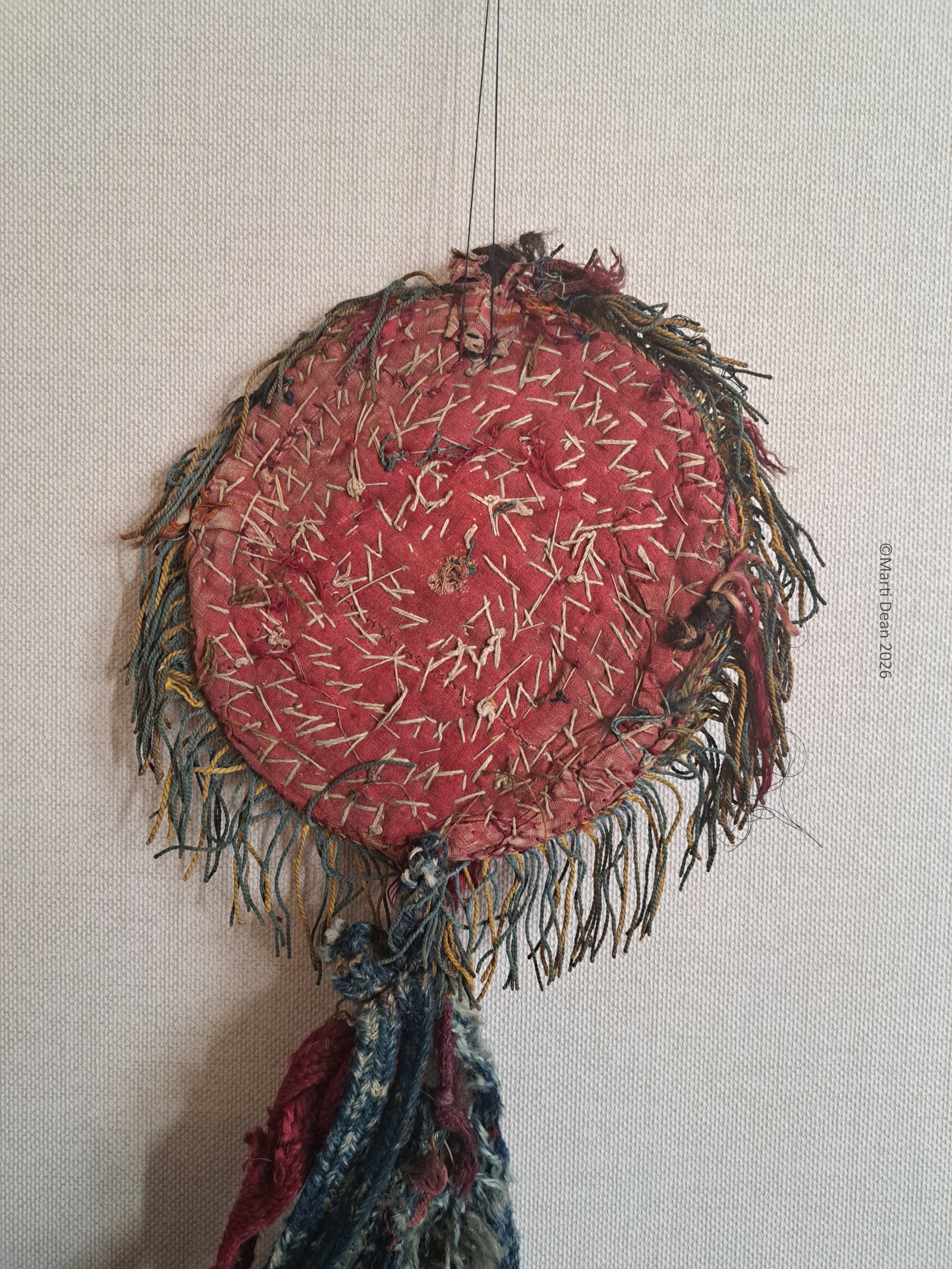
The back of a late Ottoman period nazarlik, showing original and repair stitching – Originally from Heinz Johannik’s collection.
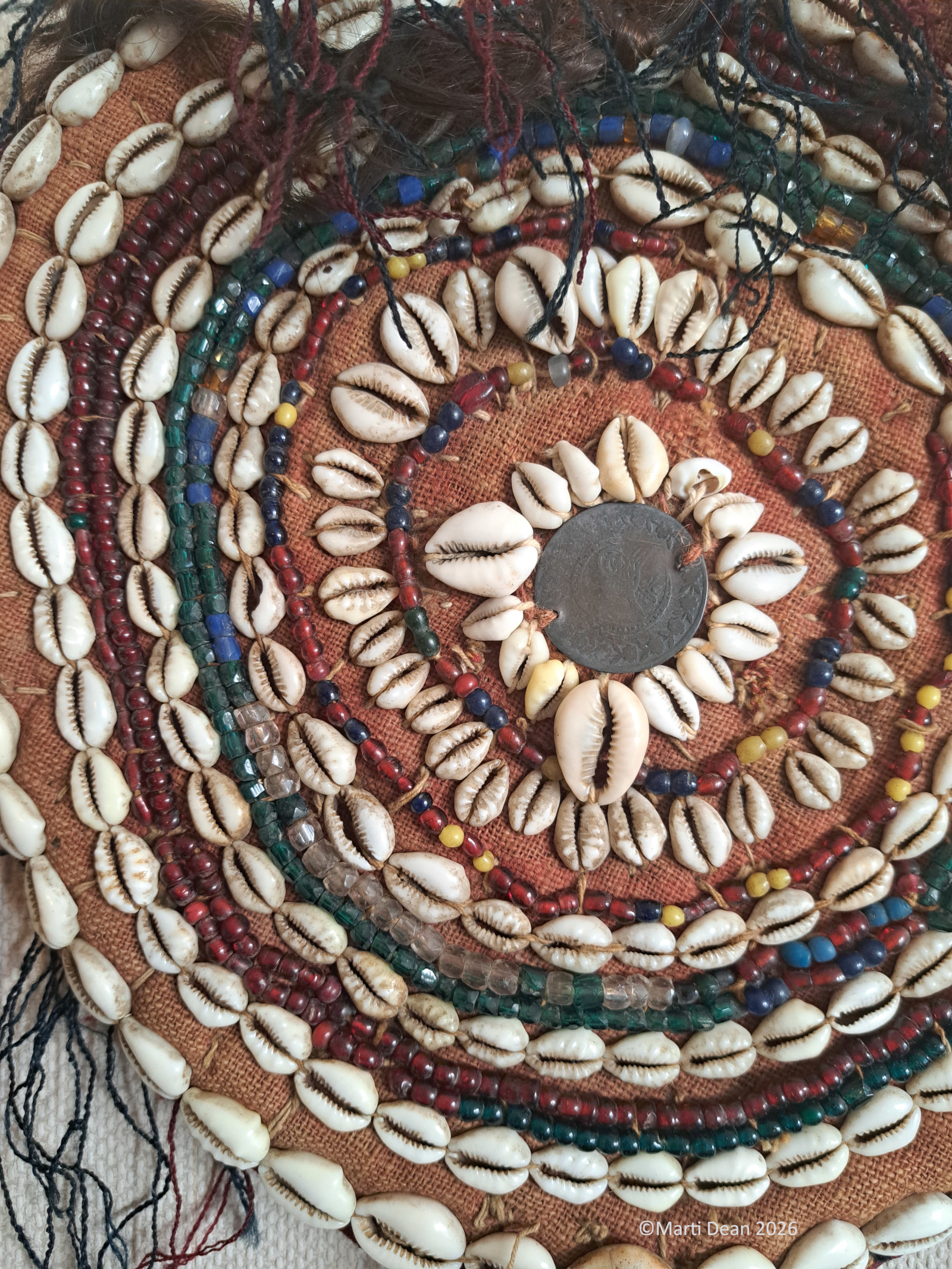
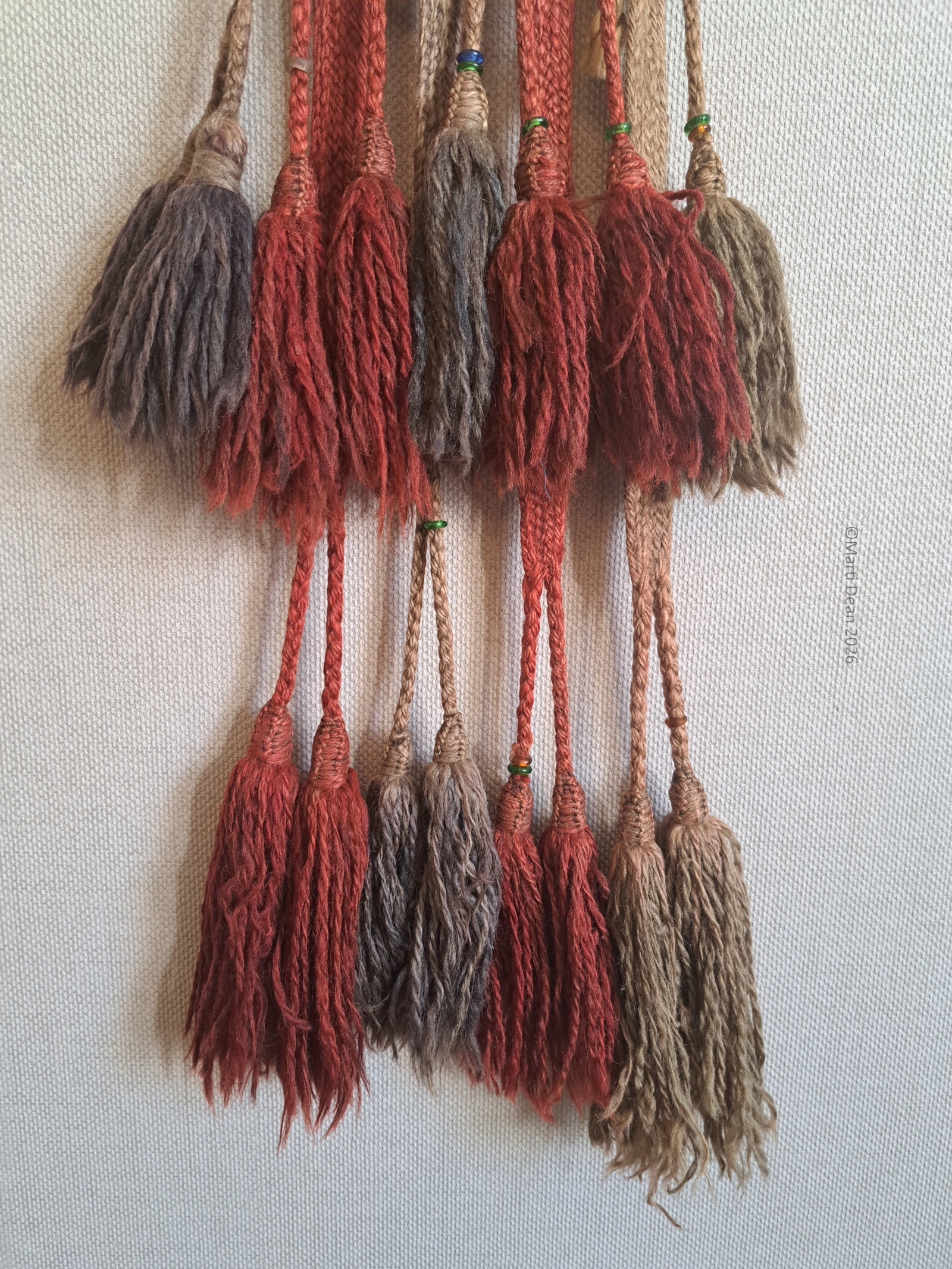
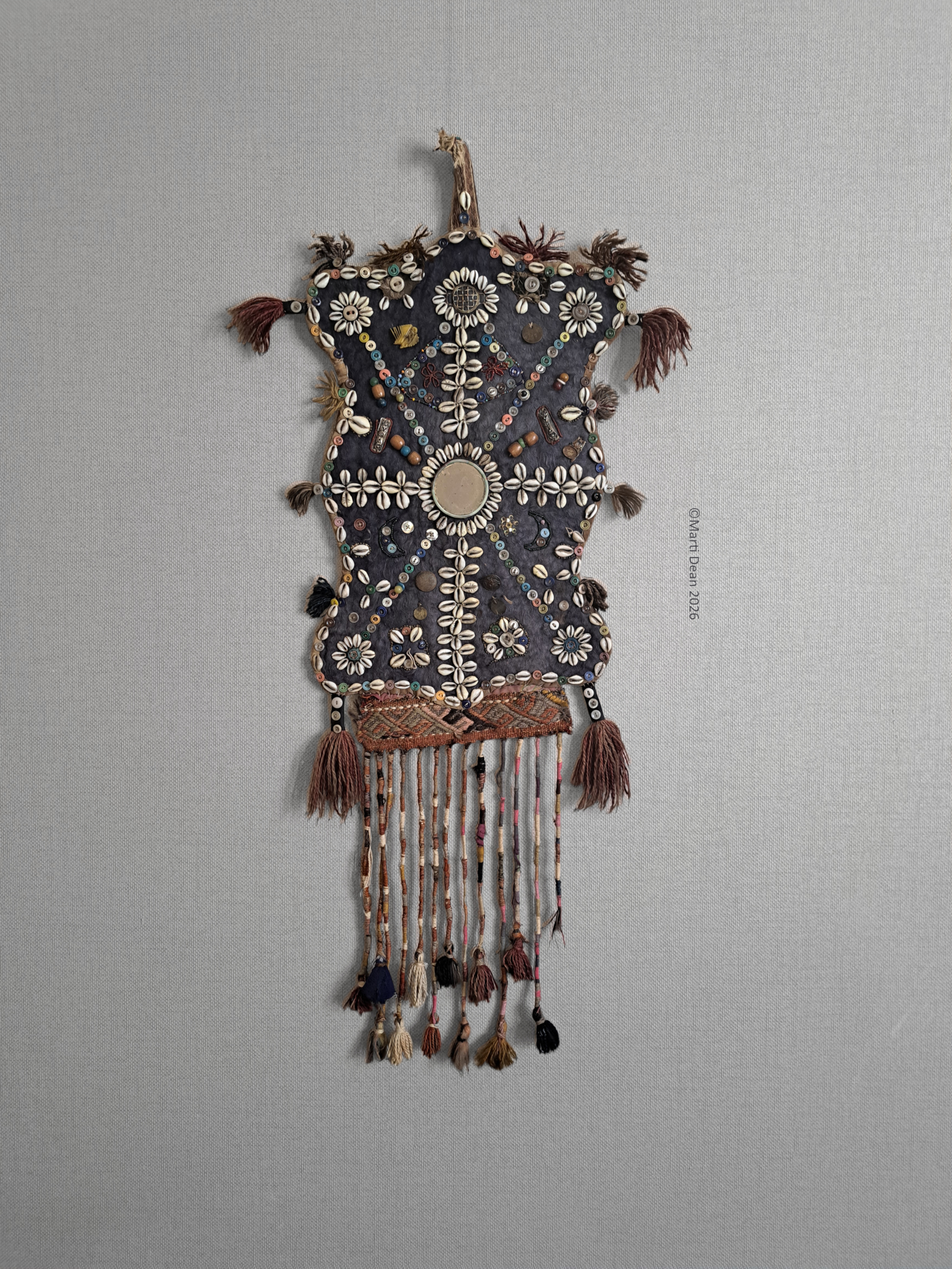
Late 19th/ early 20th century nazarliks now in the author's collection, originally from Heinz Johannik - Kelimhaus Johannik, Austria.
A Custodian of Small Histories
My interest in nazarlık has also introduced me to many remarkable people: carpet dealers, archaeologists, textile specialists and craftspeople whose knowledge and generosity have enriched my understanding of Türkiye. Among the most memorable was a copper/silversmith working in an old family shop in the lanes of Kaleci, which had a dark green-painted frontage. He showed me photographs of his father at work, together with examples of his copper and silver craftsmanship. As a fellow smith,
I felt an immediate connection. We examined one another's work and discussed materials and techniques, sharing a common understanding.
Over nearly thirty years, my collection of nazarlik has grown. They vary considerably in form, materials and age. Some have been attributed to the late nineteenth or early twentieth century, while others probably date from the latter decades of the twentieth century. Except for my first nazarlik, the precise origins of the pieces I have collected are uncertain, but each provides an opportunity to study traditional craftsmanship, imaginative creativity and the changing histories of objects. Nazarlık are expressions not only of protective belief, but also of ingenuity, craftsmanship and economic life. They belong to changing communities rather than to an idealised, unchanging past.
I do not consider myself an authority on Turkish traditions. I am a collector, a maker and a curious traveller whose fascination with Türkiye began in 1997 and continues to deepen each time I visit. I regard myself as a temporary custodian of these objects. My intention is to preserve them, document their construction and provenance, and eventually find a suitable institutional home where they can be appreciated by others. Creating an online record will provide a useful reference for those who have an interest in apotropaic folk objects and the symbolic language of this fascinating Anatolian tradition.
You can visit my Nazarlik Gallery here
Research References:
1. PİRHA (27 June 2018).“İlerleyen yaşlarına rağmen el işi dokumaları yaşatmaya çalışıyorlar” [Interview with Mustafa and Zarife Bozkurt of Durukaynak (Pişnik), Adıyaman, concerning traditional weaving and çengel production]. https://pirha.org/ilerleyen-yaslarina-ragmen-el-isi-dokumalari-yasatmaya-calisiyorlar-video-127655.html/27/06/2018/
2. Berman, Kimberly Ann (2006). Carpet Weavers and Weaving in the Global Market: The Case of Turkey. Cornell University.
3. Öztürk, Bahadır (2022). “Türkiye'de 2000 Sonrası El Halısı Üretimi ve Ticareti.”
4. Solak, İbrahim (2002). “XVI. Yüzyılda Maraş ve Çevresinde Dulkadirli Türkmenleri.” Selçuk Üniversitesi Türkiyat Araştırmaları Dergisi, 12, pp. 109–154.
https://dergipark.org.tr/tr/pub/sutad/article/277004
5. Abrash Carpet & Kilim (undated). Original nazarlık purchase certificate and business card. Author's collection.
6. Author's archive (1997–2026). Photographs, acquisition records and recollections of conversations with Turkish textile dealers.
7. Bülent, Eşref (2007). “Anadolu Amulet Geleneğinde Çılkak ve Eski Kültürlerde İzleri.” In Maddi Kültür / Material Culture, 38th ICANAS, pp. 311–328. Ankara: Atatürk Kültür, Dil ve Tarih Yüksek Kurumu.
https://ayk.gov.tr/wp-content/uploads/2015/01/BÜLENT-Eşref-ANADOLU-AMULET-GELENEĞİNDE-ÇILKAK-VE-ESKİ-KÜLTÜRLERDE-İZLERİ.pdf
8. Oyman, Naile Rengin (2019).“Bazı Anadolu Kilim Motiflerinin Sembolik Çözümlemesi.” Arış, 14, pp. 4–22. https://doi.org/10.34242/akmbaris.2019.119
9. Eroğlu, Ayşe Aslıhan (2022).“Sarıkamış Kilimleri.” Arış, 20–21, pp. 275–300. https://doi.org/10.32704/akmbaris.2022.175
10. T.C. Millî Eğitim Bakanlığı, MEGEP (n.d.).Gördes Halı Dokuma, p. 22. Mesleki Eğitim ve Öğretim Sisteminin Güçlendirilmesi Projesi.
11. Gürcan Akbaş, Kevser (2020).“Türklerin Düğün Geleneklerinde Özgün Bir Tasarım: Gelin Habercisi Çengel.” IBAD Sosyal Bilimler Dergisi, 6, pp. 409–422. https://doi.org/10.21733/ibad.665065
12. Howe, R. John (2010).“Saul Barodofsky on ‘Nazarlik’.” R. John Howe: Textiles and Text, 28 February. Illustrated account of Saul Barodofsky's presentation on protective amulets and textiles.
https://rjohnhowe.wordpress.com/2010/02/28/saul-barodofsky-on-nazarlik/
13. Howe, R. John (2013).“Saul Barodofsky on ‘Camel Flowers’.” R. John Howe: Textiles and Text, 4 January. Illustrated account of Saul Barodofsky's presentation on traditional animal decorations and protective trappings. https://rjohnhowe.wordpress.com/2013/01/04/saul-barodofsky-on-camel-flowers/